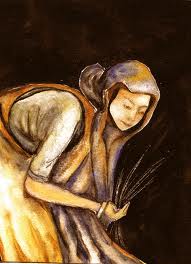
The wood so softly singing
In a language strange to hear
And the song it sings will find you
As the twilight draws you near

20130402

The View From Faery

John Anster Fitzgerald

Through the weave of our knotted ways they pushed their straight roads, and our knots remained tangled around them. Our life invisible to them, they lived theirs spun out differently in space and time, so we hardly notice any more as they make their way. But then, on a time, one looks and appears to see, finds a trace in the landscape or something other, half turns onto a twisting path through here, but then does not turn, finding after all nothing but a hint of a way through the trees, a glimpse caught in the corner of an unwary eye or the desire of an instep to turn where there is no turn at all.


We do not call to lure or entrap them, as some may think, though we reveal brief glimpses of ourselves in looking out at them, so that some may catch on us, match our steps on the edge of our world for a while, say they walk with us. Scant knowledge they gain, carrying back tales of hushed glades of enchantment, snagged on threads of space&time that is not their own for a moment, for a footfall, in our world though the next is back in their own and their senses cannot gauge the span between us. We would withdraw. But we cannot, our ways twined around theirs, so we keep our eyes averted, but fail, now and then, to avoid the straight view: to meet the questing sight of the curious few.

20130319

Stone Age Selkies?

From a series of stamps from the Faroe Islands depicting legends of the Seal Folk.
"While there is nothing unusual in finding isolated fragments of human bone in Mesolithic deposits, the find at Oronsay was rather out of the ordinary in that, of the forty or so bone fragments recovered, thirty were small bones from the hands and feet, and one of the groups of human finger bones was found to lie on a cluster of bones from a seal's flipper ... [in what] would appear to be a deliberate act of association."
Barry Cunliffe Britain Begins

20130217

RIVERS


There are 3000 graceful-ankled Okeanids; widely-scattered they haunt the earth and the depths of the waters everywhere alike, shining goddess-children. And there are as many again of the Rivers that flow with splashing sound, offsprings of Okeanus that Lady Tethys bore. It is hard for mortal man to tell the names of them all, but each of them are known to the peoples who live near them.
(Hesiod - 8th century b.c.e)

20130117

Eibhlín Ní Ghuinníola

There are several stories in the Irish folklore record of a healing woman called Eibhlín Ní Ghuinníola. One of the things said about her was that she had a fairy lover who was seen with her when she was out gathering herbs.

In a commentary on the stories, Gearóid Ó Crualaoich says:

" … that a 'fairy lover' , a leannán sí was often seen with Eibhlín Ní Ghuinníola as she gathered plants. The Saol Sí, the fairy realm, is the ancestral cultural embodiment of that imaginative mythological and spiritual otherworld lying beyond the 'normal' ranges of human perception. It can, on occasion, manifest itself in figures like the leannán sí, as well as the Cailleach-goddess, or in the activities - and in the narrative of the activities - of those women who fulfilled the social roles of wise healer, keening-woman or country midwife. Such women, acting decisively in the face of affliction and life crisis, draw their autonomy and legitimacy from the tradition and the traditional narratives of the Cailleach-goddess and in the narratives of former occupiers of their own roles such as Eibhlín Ní Ghuinníola".

from The Book of the Cailleach

20130111

Otherworld


I was alerted to the publication OTHERWORLD on the excellent TAIRIS blog. It's a collection of Irish songs of the Otherworld realms on a CD (sample above) which comes as part of a definitive book on the subject reviewed HERE

It seems to me indispensable. And if you buy it from Kenny's of Galway it's cheaper than Amazon:

http://www.bookshop.kennys.ie/book/IE/9780956562838/The_Otherworld_Music__Song_from_Irish_Tradition

20130102

The Woman Who Used To See The Fairies

An old woman lived in Gleann Fhreastail one time and she was aged and wise. It was said that she used to see the fairies. I don't know myself. Any wake she used attend, she frequently went off into a weakness during it. She would be a long time in the swoon before she would come out of it. It was out of those fainting fits that she'd used to bring prophetic knowledge, so they said.

Irish Folklore Commission Vol 30

*
There was a woman here long ago they used to call Máire Ní Mhurchú she lived at Eyeries Beg. She lived in many other places too, along with that, and she was no sooner in one place than in another. It used to be said, and I suppose it was a true saying, that she used to go with the fairies and the people of the night. This night, she was back in the west with some women who were stripping flax …..

[The women are working all night at this task and are without tobacco for their clay pipes as they are awaiting the arrival of carters with supplies from Cork some distance away]

….. when it was getting on for midnight, footsteps came to the door and there was a knock on the door. Máire Ní Mhurchú , the poor woman, took her cloak and bade them goodnight and went out the door.

When day broke she came in drowned wet and prostrate with exhaustion. They put her up to the fire , put dry clothes on her and were trying to revive her since she was almost dead.

When she came to she was very satisfied that they had made so much of her and she told them that the carters were not far away …, that she had passed them as they were coming down Loch á Bhoun and they would be there tomorrow. They did not believe that she could have arrived so quickly from Loch á Bhoun except that a few of them knew of her journeying. But it was true for the carters arrived the next day and then they all believed her.

Irish Folklore Commission Vol 623

Collected in Irish

20121125

Becfola in Faery

Becfola by Arthur Rackham


She left the palace with one maid, and as she crossed the doorway something happened to her, but by what means it happened would be hard to tell; for in the one pace she passed out of the palace and out of the world, and the second step she trod was in Faery, but she did not know this. Her intention was to go to Cluain da chaillech to meet Crimthann, but when she left the palace she did not remember Crimthann any more. To her eye and to the eye of her maid the world was as it always had been, and the landmarks they knew were about them. But the object for which they were travelling was different, although unknown, and the people they passed on the roads were unknown, and were yet people that they knew. They set out southwards from Tara into the Duffry of Leinster, and after some time they came into wild country and went astray. At last Becfola halted, saying: "I do not know where we are." The maid replied that she also did not know.


James Stephens from Irish Fairy Tales