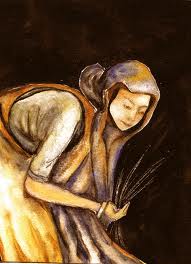
The wood so softly singing
In a language strange to hear
And the song it sings will find you
As the twilight draws you near

20130117

Eibhlín Ní Ghuinníola

There are several stories in the Irish folklore record of a healing woman called Eibhlín Ní Ghuinníola. One of the things said about her was that she had a fairy lover who was seen with her when she was out gathering herbs.

In a commentary on the stories, Gearóid Ó Crualaoich says:

" … that a 'fairy lover' , a leannán sí was often seen with Eibhlín Ní Ghuinníola as she gathered plants. The Saol Sí, the fairy realm, is the ancestral cultural embodiment of that imaginative mythological and spiritual otherworld lying beyond the 'normal' ranges of human perception. It can, on occasion, manifest itself in figures like the leannán sí, as well as the Cailleach-goddess, or in the activities - and in the narrative of the activities - of those women who fulfilled the social roles of wise healer, keening-woman or country midwife. Such women, acting decisively in the face of affliction and life crisis, draw their autonomy and legitimacy from the tradition and the traditional narratives of the Cailleach-goddess and in the narratives of former occupiers of their own roles such as Eibhlín Ní Ghuinníola".

from The Book of the Cailleach

20130111

Otherworld


I was alerted to the publication OTHERWORLD on the excellent TAIRIS blog. It's a collection of Irish songs of the Otherworld realms on a CD (sample above) which comes as part of a definitive book on the subject reviewed HERE

It seems to me indispensable. And if you buy it from Kenny's of Galway it's cheaper than Amazon:

http://www.bookshop.kennys.ie/book/IE/9780956562838/The_Otherworld_Music__Song_from_Irish_Tradition

20130102

The Woman Who Used To See The Fairies

An old woman lived in Gleann Fhreastail one time and she was aged and wise. It was said that she used to see the fairies. I don't know myself. Any wake she used attend, she frequently went off into a weakness during it. She would be a long time in the swoon before she would come out of it. It was out of those fainting fits that she'd used to bring prophetic knowledge, so they said.

Irish Folklore Commission Vol 30

*
There was a woman here long ago they used to call Máire Ní Mhurchú she lived at Eyeries Beg. She lived in many other places too, along with that, and she was no sooner in one place than in another. It used to be said, and I suppose it was a true saying, that she used to go with the fairies and the people of the night. This night, she was back in the west with some women who were stripping flax …..

[The women are working all night at this task and are without tobacco for their clay pipes as they are awaiting the arrival of carters with supplies from Cork some distance away]

….. when it was getting on for midnight, footsteps came to the door and there was a knock on the door. Máire Ní Mhurchú , the poor woman, took her cloak and bade them goodnight and went out the door.

When day broke she came in drowned wet and prostrate with exhaustion. They put her up to the fire , put dry clothes on her and were trying to revive her since she was almost dead.

When she came to she was very satisfied that they had made so much of her and she told them that the carters were not far away …, that she had passed them as they were coming down Loch á Bhoun and they would be there tomorrow. They did not believe that she could have arrived so quickly from Loch á Bhoun except that a few of them knew of her journeying. But it was true for the carters arrived the next day and then they all believed her.

Irish Folklore Commission Vol 623

Collected in Irish

20121125

Becfola in Faery

Becfola by Arthur Rackham


She left the palace with one maid, and as she crossed the doorway something happened to her, but by what means it happened would be hard to tell; for in the one pace she passed out of the palace and out of the world, and the second step she trod was in Faery, but she did not know this. Her intention was to go to Cluain da chaillech to meet Crimthann, but when she left the palace she did not remember Crimthann any more. To her eye and to the eye of her maid the world was as it always had been, and the landmarks they knew were about them. But the object for which they were travelling was different, although unknown, and the people they passed on the roads were unknown, and were yet people that they knew. They set out southwards from Tara into the Duffry of Leinster, and after some time they came into wild country and went astray. At last Becfola halted, saying: "I do not know where we are." The maid replied that she also did not know.


James Stephens from Irish Fairy Tales

20121031

The Washer at the Ford


Who sits by the ford, wringing her hands as she wrings the rags of the old year? She is old and weary and her lament is an eerie background rattle against the sounds of the rushing stream and the whine of the wind through the trees as their leaves fall onto chill waters or drift away on the back of the wind.

Would you cross the ford? Will you meet her in the swirling waters? She may ask you a riddle. She may ask for a rhyme. Or require you to wring out a rag for her.

"Where are you going my pretty one?"

What will you answer?

"I bring you a gift old Elder Mother. I bring you some wine from the berries of your tree. I pour it here now your leaves are fled and carried away on the wind with your sighs."

"Pour your wine then", she may reply, out of her emptiness, out of the cave of her endless night. And her plaintive voice say:
"Shall you pass?"

Why is it you that should answer that question?

"O Wraith of the Night, what I have brought thee is truly offered and comes from my heart. It is but a token of what I can offer, out of becoming when nothing is."

"Then pass, o neophyte of the Night, pass with the winter that is upon us. When that has passed and you have crossed over, the way shall be open and the deed is done."

And the deed is done.


20121018

The Witch of Ben-y-Gloe

Two scottish deer poachers were caught in a storm in the mountains and went astray. They spent the night in the best shelter they could find but the next day was little better and their provisions were running out. The lands they thought they knew so well were strange to them as they tried to find a way home. As darkness fell, and they feared another night in the open, they saw a bothy up ahead. They approached it, not expecting anyone to be using it so late in the season, but as they reached it an old woman, wild and haggard looking, beckoned them inside. She told them she had been expecting them, and their supper and beds were ready. She stirred soup in a bubbling cauldon as she crooned a song in an unfamiliar language. The men sat terrified, unable to eat as the old woman held up a rope with three knots in it and told them of her power over the weather:

“If I loosen the first knot there shall blaw a fair wind, such as any deer stalker may wish; if I loosen the second, a stronger blast shall sweep o’er the hills; and if I loosen the third, such a storm will brake out, as neither man nor beast can suffer; and the blast shall yowl down the corries and the glens, and the pines shall fall crashin into the torrents, and this bare arm shall guide the course o the storm, as I sit on my throne of Cairn-Gower, on the peak o Ben-y-Gloe. Well did ye ken my power the day, when the wind was cauld and deadly, and all was dimmed with snow - and ye see that ye was expectit here, and ye have brought no venison; but if ye mean to thrive, ye must place a fat hart, or a barren hind in the Braes o’ Atholl, by Fraser’s cairn, at midnight, the first Monday in every month, while the season lasts. If ye neglect my bidding, foul will befall ye, and the fate of Walter o Rhuairm shall overtake ye; ye shall surely perish in the waste; the raven shall croak yer dirge; and yer bones shall be picked by the eagle.”

The poachers gave their word to do as the old woman asked, ate her food and fell into a deep sleep.  When they awoke the bothy was deserted and there was no sign of the old woman. The storm had abated and the men were able to find their way home. It is assumed that they kept their word and left the offerings of deer as instructed.

[adapted from] William Scrope The Art of Deer Stalking (1839) also referred to in Visions of the Cailleach David Rankine and Sorita d'Este (2009)

20121011

Arthur's Stone


Arthur's Stone - Herefordshire, near the border with Wales


Joseph Gwynne told me that when he was a boy the great stone called Arthur's Stone was much longer than it is now. A hundred sheep could lie under the shadow of it. Also the stone stood much higher on the supporting pillars than it does at present, so high indeed that an ordinary sized man could walk under it. Across the green lane and opposite the stone was a rock lying flat on the ground on which were imprinted the marks of a man's knees and fingers. These marks were believed to have been made by King Arthur when he heaved the stone up on his back and set it on the pillars.

Kilvert's Diary 1878

***


"Arthur and his huntsmen to hunt the Twrch Trwyth. He is a man of great power, but he will not help you, for he is one of mine."

The giant Ysbaddaden Pencawr
in Culhwch and Olwen (11th cent.)