The wood so softly singing
In a language strange to hear
And the song it sings will find you
As the twilight draws you near

20130730

The Sex of the Moon

Another Archive item from the Pagan Movement newsletters by Tony Kelly:

The sex of the Moon is a trick of language, but this trick of language must itself have its origin in myth. The Moon tends to be masculine in the Teutonic and Slavic languages and feminine in the Romance and Celtic.

I thought the Moon magical for as far back as I can remember and have many happy memories of her. When I was young I used to stay with my grandmother, who had many fascinating tales to tell me about all sorts of things that were old, and my uncle lived there too and did astrology and told me about the pull of the Moon on the tides, and I was in awe for the mysterious force that the Moon exerted, and I don't know if this was for the sheer wonder of it, or because my uncle was himself in awe of it and his awe was infectious. But I used to lie in bed at night, just under the window and next to my grandmother who slept in a big bed alongside, and more often than not, the Moon would be high in the sky, always it seemed, big, bright and full. She sailed high in the clouds, dashed from cloud bank to cloud bank, and I was saddened when she was hidden, and elated when she burst through in a dazzle of silvery light again. It was beautiful, but it was also magical, serene, and strangely powerful. It seemed liked hours that I used to lie there watching her, and though I didn't put it into words, it was then that I fell in love with her and I've been deeply in love with her ever since. They say you go mad' if you sleep in the light of the Moon. I'm not surprised. If they'd told me that before I'd done it, I'd have done it purposely! But I wouldn't call it madness. Rather I'd call it enchantment. It's a strange feeling. Ancient. And beautiful.

20130709

So old, so very long ago ....

The wood was vast and there was no sky overhead. The trees were immensely tall and very old, and belonged to the forest. They were separate trees and communicated as trees do, but they were also part of the pulse of the woodland. There was something intense about them, not human, very, very old, and the moisture on them and the tree mosses belonged to the forest. It would be perilous to interfere with them, yet it would be sacrilegious too. You couldn't help loving them because they were magic, but loving them because they were trees and because they belonged to the forest.
The light was darkened as it is in the greenwood and there were paths. But it was very quiet, and peaceful, and strangely menacing, and loveable. It wasn't the sort of place you'd want to be alone in. And it wasn't the sort of place you'd want to leave. It's the sort of place that, if a god had appeared with horns and cloven feet and the magic pipes, you wouldn't be too surprised.
And there was something alluring, and bewitching, and magic about it. The trees and everything growing in the greenwood was alive and it was aware, but it wasn't human awareness. It was the diffused mind of the woodland, as much one tree as another, and as much all of them, but not divided. A presence. Thinking. Brooding. Aware of the people in its midst. It was vast, but deep and quiet, immensely powerful, but passive. It was green thinks, and it belonged to all that grows in the greenwood, and all the plants that come from her womb. And green thinks are not like red thinks. They're old, and they were old when red thinks were young. Old memories, an aching sadness, and separation, but so long ago. But here in the greenwood, we were in the presence of green thinks, in its own land, on sacred ground, and the faerie mind was more powerful than the human, beckoning, but menacing, threatening, but loving. So old, so very long ago.....


TONY KELLY (circa 1970) from The Pagan Movement Archive

20130511

Dymchurch Flit

Hobden broke open the potato and ate it with the curious neatness of men who make most of their meals in the blowy open. 'She growed to be quite reasonable-like after livin' in the Weald awhile, but our first twenty year or two she was odd-fashioned, no bounds. And she was a won'erful hand with bees.' He cut away a little piece of potato and threw it out to the door.

'Ah! I've heard say the Whitgifts could see further through a millstone than most,' said Shoesmith. 'Did she, now?'

'She was honest-innocent of any nigromancin',' said Hobden. 'Only she'd read signs and sinnifications out o' birds flyin', stars fallin', bees hivin', and such. An, she'd lie awake--listenin' for calls, she said.'

'That don't prove naught,' said Tom. 'All Marsh folk has been smugglers since time everlastin'. 'Twould be in her blood to listen out o' nights.'

'Nature-ally,' old Hobden replied, smiling. 'I mind when there was smugglin' a sight nearer us than what the Marsh be. But that wasn't my woman's trouble. 'Twas a passel o' no-sense talk'--he dropped his voice--'about Pharisees.'

'Yes. I've heard Marsh men belieft in 'em.'Tom looked straight at the wide-eyed children beside Bess.

'Pharisees,' cried Una. 'Fairies? Oh, I see!'

'People o' the Hills,' said the Bee Boy, throwing half of his potato towards the door.

'There you be!' said Hobden, pointing at him. My boy--he has her eyes and her out-gate sense. That's what she called 'em!'

'And what did you think of it all?'

'Um--um,' Hobden rumbled. 'A man that uses fields an' shaws after dark as much as I've done, he don't go out of his road excep' for keepers.'

'But settin' that aside?' said Tom, coaxingly. 'I saw ye throw the Good Piece out-at-doors just now. Do ye believe or--do ye?'

'There was a great black eye to that tater,' said Hobden indignantly.

'My liddle eye didn't see un, then. It looked as if you meant it for--for Any One that might need it. But settin' that aside, d'ye believe or--do ye?'

'I ain't sayin' nothin', because I've heard naught, an' I've see naught. But if you was to say there was more things after dark in the shaws than men, or fur, or feather, or fin, I dunno as I'd go far about to call you a liar. Now turn again, Tom. What's your say?'

'I'm like you. I say nothin'. But I'll tell you a tale, an' you can fit it as how you please.'

'Passel o' no-sense stuff,' growled Hobden, but he filled his pipe.

'The Marsh men they call it Dymchurch Flit,'Tom went on slowly. 'Hap you have heard it?'

'My woman she've told it me scores o' times. Dunno as I didn't end by belieftin' it--sometimes.

Hobden crossed over as he spoke, and sucked with his pipe at the yellow lanthorn flame. Tom rested one great elbow on one great knee, where he sat among the coal.

'Have you ever bin in the Marsh?' he said to Dan.

'Only as far as Rye, once,' Dan answered.

'Ah, that's but the edge. Back behind of her there's steeples settin' beside churches, an' wise women settin' beside their doors, an' the sea settin' above the land, an' ducks herdin' wild in the diks' (he meant ditches). 'The Marsh is just about riddled with diks an' sluices, an' tide-gates an' water-lets. You can hear 'em bubblin' an' grummelin' when the tide works in 'em, an' then you hear the sea rangin' left and right-handed all up along the Wall. You've seen how flat she is--the Marsh? You'd think nothin' easier than to walk eend-on acrost her? Ah, but the diks an' the water-lets, they twists the roads about as ravelly as witch-yarn on the spindles. So ye get all turned round in broad daylight.'

Rudyard Kipling from Puck of Pook's Hill

20130402

The View From Faery

John Anster Fitzgerald

Through the weave of our knotted ways they pushed their straight roads, and our knots remained tangled around them. Our life invisible to them, they lived theirs spun out differently in space and time, so we hardly notice any more as they make their way. But then, on a time, one looks and appears to see, finds a trace in the landscape or something other, half turns onto a twisting path through here, but then does not turn, finding after all nothing but a hint of a way through the trees, a glimpse caught in the corner of an unwary eye or the desire of an instep to turn where there is no turn at all.


We do not call to lure or entrap them, as some may think, though we reveal brief glimpses of ourselves in looking out at them, so that some may catch on us, match our steps on the edge of our world for a while, say they walk with us. Scant knowledge they gain, carrying back tales of hushed glades of enchantment, snagged on threads of space&time that is not their own for a moment, for a footfall, in our world though the next is back in their own and their senses cannot gauge the span between us. We would withdraw. But we cannot, our ways twined around theirs, so we keep our eyes averted, but fail, now and then, to avoid the straight view: to meet the questing sight of the curious few.

20130319

Stone Age Selkies?

From a series of stamps from the Faroe Islands depicting legends of the Seal Folk.
"While there is nothing unusual in finding isolated fragments of human bone in Mesolithic deposits, the find at Oronsay was rather out of the ordinary in that, of the forty or so bone fragments recovered, thirty were small bones from the hands and feet, and one of the groups of human finger bones was found to lie on a cluster of bones from a seal's flipper ... [in what] would appear to be a deliberate act of association."
Barry Cunliffe Britain Begins

20130217

RIVERS


There are 3000 graceful-ankled Okeanids; widely-scattered they haunt the earth and the depths of the waters everywhere alike, shining goddess-children. And there are as many again of the Rivers that flow with splashing sound, offsprings of Okeanus that Lady Tethys bore. It is hard for mortal man to tell the names of them all, but each of them are known to the peoples who live near them.
(Hesiod - 8th century b.c.e)

20130117

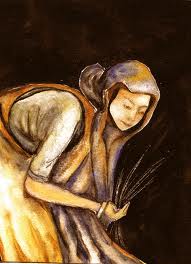
Eibhlín Ní Ghuinníola

There are several stories in the Irish folklore record of a healing woman called Eibhlín Ní Ghuinníola. One of the things said about her was that she had a fairy lover who was seen with her when she was out gathering herbs.

In a commentary on the stories, Gearóid Ó Crualaoich says:

" … that a 'fairy lover' , a leannán sí was often seen with Eibhlín Ní Ghuinníola as she gathered plants. The Saol Sí, the fairy realm, is the ancestral cultural embodiment of that imaginative mythological and spiritual otherworld lying beyond the 'normal' ranges of human perception. It can, on occasion, manifest itself in figures like the leannán sí, as well as the Cailleach-goddess, or in the activities - and in the narrative of the activities - of those women who fulfilled the social roles of wise healer, keening-woman or country midwife. Such women, acting decisively in the face of affliction and life crisis, draw their autonomy and legitimacy from the tradition and the traditional narratives of the Cailleach-goddess and in the narratives of former occupiers of their own roles such as Eibhlín Ní Ghuinníola".

from The Book of the Cailleach